
ArticleCapital & Transactions
KFC and Pizza Hut Operators’ Merger: M&A Synergy Analysis
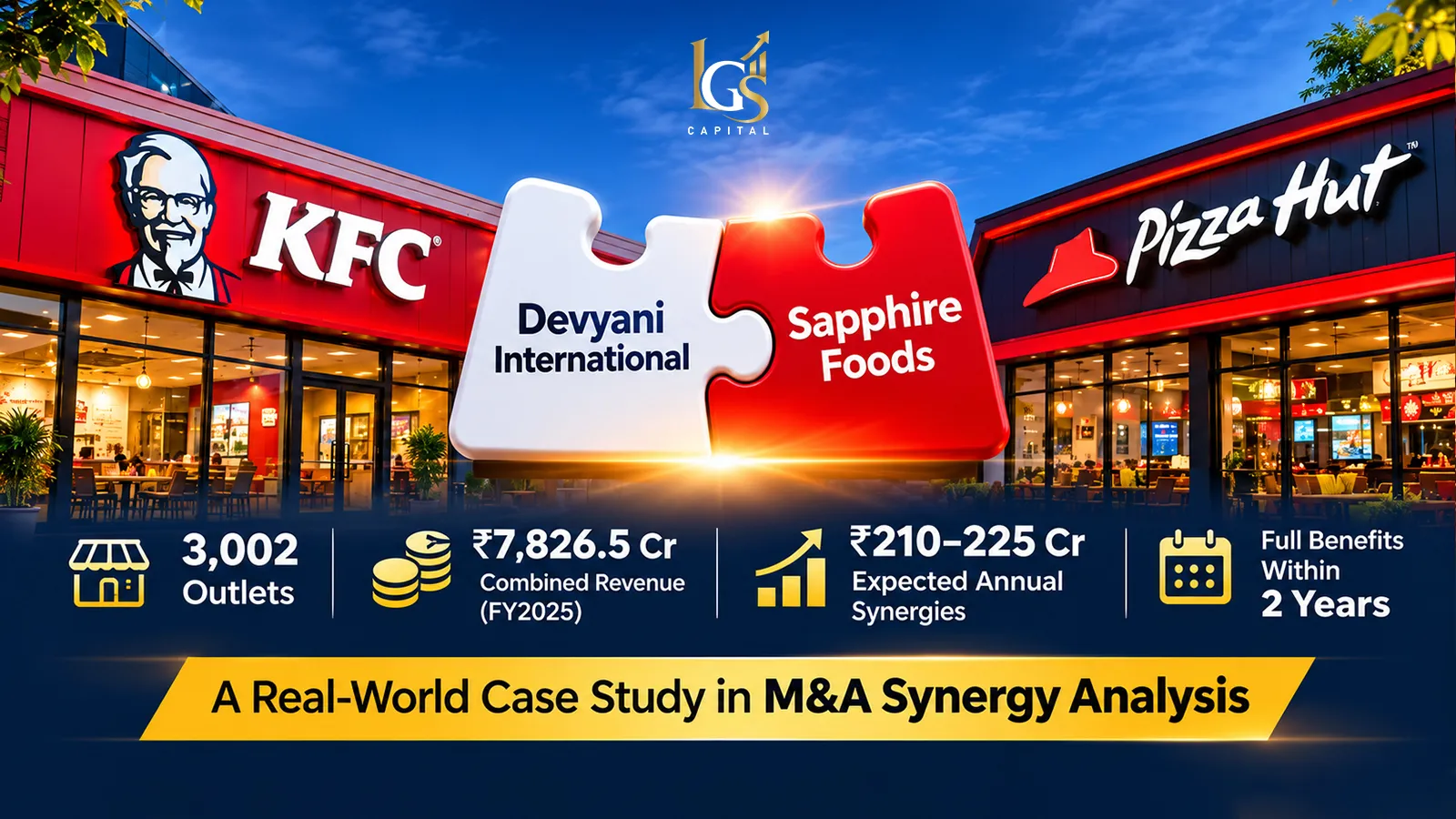
The proposed merger of Devyani International and Sapphire Foods could create one of India's largest quick-service restaurant operators, with more than 3,000 outlets and expected annual synergy benefits of ₹210–225 crore.
- Written by
- LGS Editorial Team
- Published
- Reading time
- 9-minute read
For anyone assessing the transaction, the question goes beyond how many restaurants the combined company will operate.
What could those restaurants do better under one company?
That is the question M&A synergy analysis should answer. It examines where a combination could improve earnings, what changes are needed, and whether the benefits justify the cost.
The Devyani–Sapphire merger offers a useful example because the expected opportunities involve familiar business expenses: purchasing, distribution, technology, and marketing.
What Is the Devyani–Sapphire Merger?
On January 1, 2026, Devyani International and Sapphire Foods announced their proposed merger. The Competition Commission of India subsequently approved the transaction, with the government publishing its announcement on October 31, 2026.
Both companies operate KFC and Pizza Hut franchise outlets in India.
The distinction matters: the companies operating the outlets are merging. KFC and Pizza Hut remain separate restaurant brands.
Key Details of the Proposed Merger
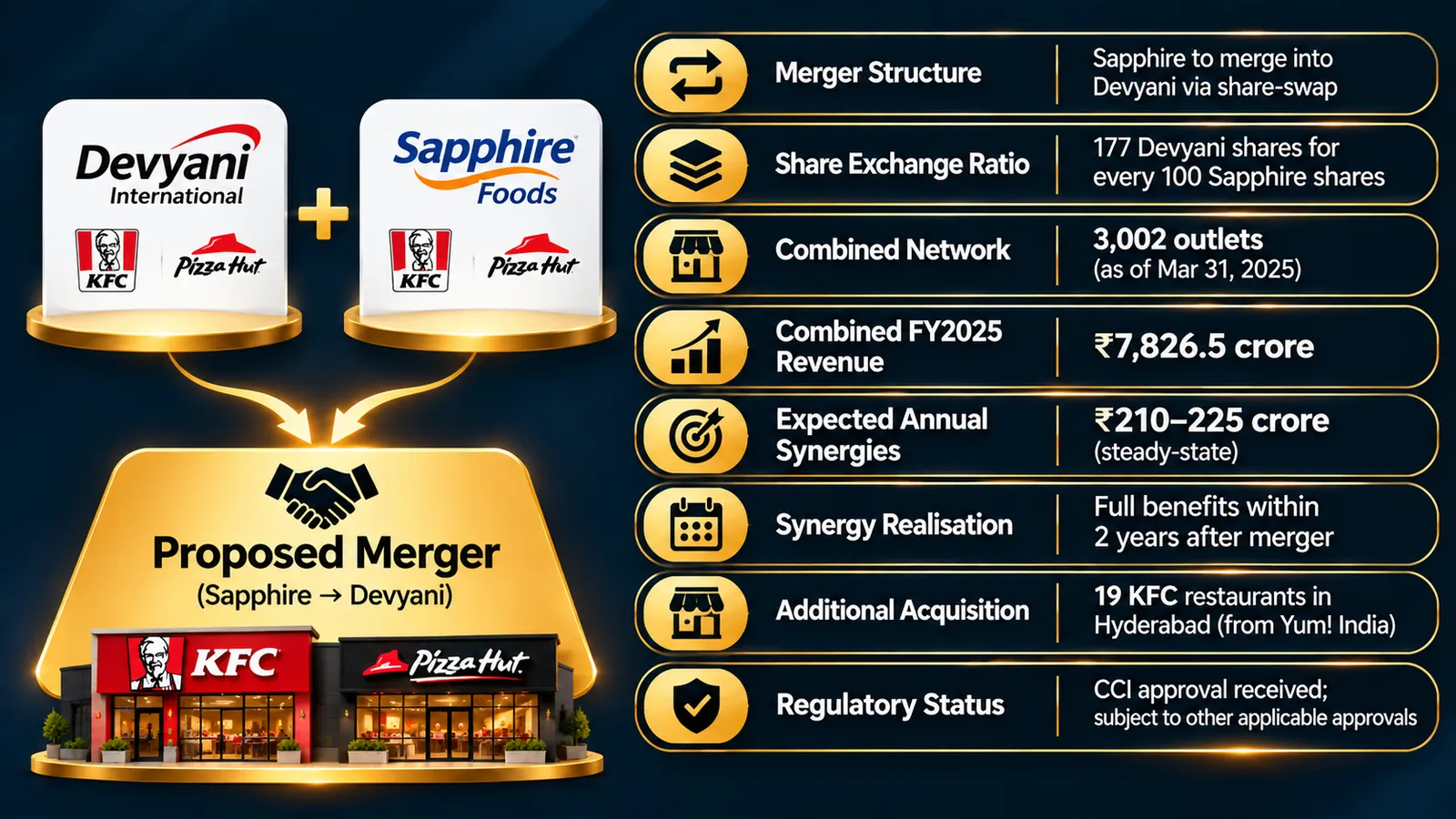
- Merger structure: Sapphire Foods India Limited will merge into Devyani International Limited through a share-swap arrangement.
- Share exchange ratio: Sapphire shareholders will receive 177 Devyani shares for every 100 Sapphire shares.
- Combined restaurant network: 3,002 outlets based on March 31, 2025, figures.
- Combined FY2025 revenue: Approximately ₹7,826.5 crore.
- Expected annual synergies: ₹210–225 crore on a steady-state basis.
- Synergy realisation: Management expects the full benefits within two years after the merger.
- Additional acquisition: Devyani will acquire 19 KFC restaurants in Hyderabad currently operated by Yum! India.
- Regulatory status: CCI approval has been received, while the transaction remains subject to other applicable approvals.
The merger is intended to improve operational efficiency, strengthen financial capabilities, and support the expansion of the combined restaurant network.
However, the expected size of the combined business does not automatically establish the additional value the merger will create.
To assess that value, management needs to examine what could improve after the businesses come together.
What Is M&A Synergy Analysis?
M&A synergy analysis assesses the additional financial and operating benefits expected from combining businesses.
Those benefits generally involve reducing costs, increasing revenue, or making better use of assets and capabilities. The assessment also needs to account for integration spending and the time required to achieve results.
For example, two companies may expect to save money by moving to a common technology platform. The saving becomes meaningful only after considering migration costs, training, ongoing support, and any disruption during the transition.
A useful analysis connects each forecast benefit with evidence:
- Financial impact: Which expense will fall or which revenue source will grow?
- Operational changes: What needs to change to achieve the benefit?
- Integration costs: How much will implementation cost?
- Realisation timeline: When should the benefit appear?
- Accountability: Who will be responsible for delivering it?
Without those answers, the estimate is difficult to evaluate or track after completion.
What the Latest Devyani–Sapphire Financials Reveal
The proposed merger comes as both restaurant operators are expanding their networks and working to improve profitability.
Their Q2 FY2026–27 financial results, covering July to September 2026, provide a more recent picture of their operations.
Devyani International
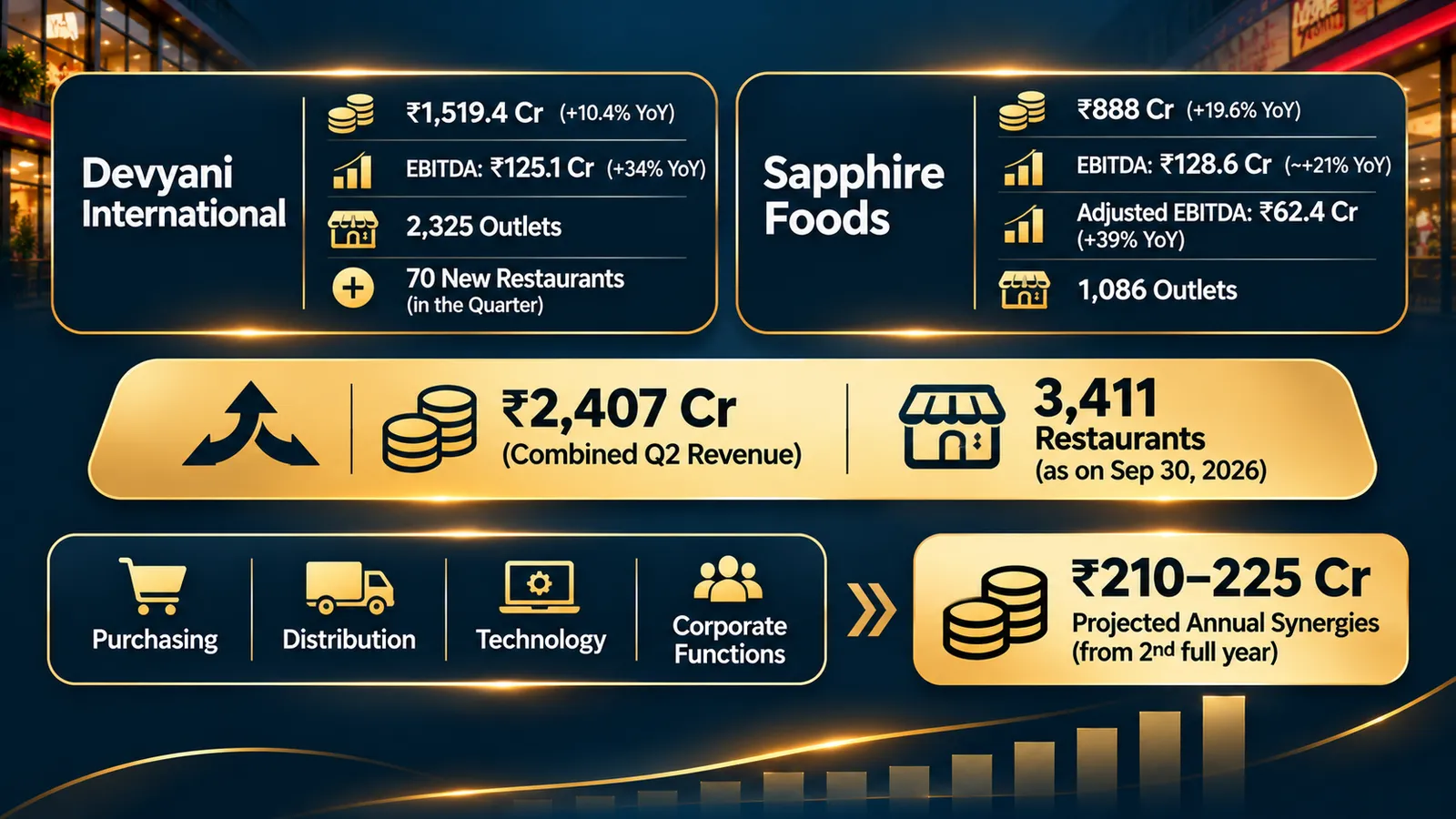
- Revenue: ₹1,519.4 crore, up 10.4% year-on-year.
- Operating EBITDA: ₹125.1 crore, up 34% year-on-year.
- Global restaurant network: 2,325 outlets.
- New restaurants added during the quarter: 70.
Sapphire Foods
- Revenue: ₹888 crore, up 19.6% year-on-year.
- Reported EBITDA: ₹128.6 crore, up approximately 21% year-on-year.
- Global restaurant network: 1,086 outlets.
- Adjusted EBITDA: ₹62.4 crore, up 39% year-on-year.
What These Figures Mean for the Merger
Together, the two operators reported approximately ₹2,407 crore in quarterly revenue and operated 3,411 restaurants as of September 30, 2026.
The scale of their operations creates opportunities to coordinate purchasing, distribution, technology, and corporate functions.
The companies' original merger announcement projected ₹210–225 crore in annual synergy benefits from the second full year after completion.
However, achieving those benefits will depend on integration costs, operational efficiencies, and how effectively the combined business manages its expanding restaurant network.
This is where M&A synergy analysis becomes important. It helps determine whether the expected financial improvements are realistic, measurable, and sufficient to justify the transaction.
Potential Synergies in the KFC and Pizza Hut Operators' Merger
The proposed Devyani–Sapphire combination aims to create opportunities across procurement, supply chains, technology, marketing, and corporate functions.
According to the companies' investor presentation, management expects annual synergy benefits of ₹210–225 crore on a steady-state basis, with full realisation targeted within two years after the merger.
The following areas explain where these benefits could emerge and how businesses can assess them. The companies have not disclosed a detailed financial breakdown of the expected savings by function.
Procurement and Supplier Terms
A larger purchasing requirement may help a business negotiate better supplier terms.
With a combined network of more than 3,000 restaurants, Devyani and Sapphire expect opportunities through centralised procurement across outlets operating the same brands.
Potential benefits include:
- Better supplier pricing through higher purchasing volumes.
- Standardised procurement processes across eligible outlets.
- Greater negotiating capacity for common materials and ingredients.
- Improved purchasing and inventory planning.
However, management needs to establish which purchases can actually be combined. Existing contracts, product specifications, supplier capacity, and delivery requirements may affect the outcome.
The relevant figure is the total cost of supplying the network. A lower purchase price may offer limited benefit if transport, storage, or wastage costs increase.
Supply Chain Coordination
Combining operations may create opportunities to review warehouses, delivery routes, and inventory planning.
The merger agreement also provides for technology and supply-chain responsibilities for KFC and Pizza Hut to transition gradually to Devyani.
Areas worth assessing include:
- Coordination of distribution networks and logistics.
- Improved inventory visibility across locations.
- Reduced duplication in supply-chain management.
- Better planning of deliveries and stock requirements.
For restaurant businesses, reliability remains essential. An outlet needs the right stock at the right time, regardless of changes taking place at the corporate level.
Any proposed saving should therefore be tested against delivery performance, stock availability, and product quality.
Technology and Shared Functions
Two operators may maintain systems or support functions that perform similar work. A common arrangement could reduce duplication and make reporting more consistent.
The proposed merger specifically identifies unified technology initiatives and reduced corporate overheads as potential sources of synergy.
Possible improvements include:
- Integration of technology platforms and reporting systems.
- Consolidation of overlapping administrative functions.
- Greater consistency in operational data.
- Lower duplication in selected corporate expenses.
The transition still needs a budget. Software changes, data transfers, training, and implementation support can consume a substantial part of the expected benefit.
Management should assess these costs before including the full annual saving in its forecast.
Marketing and Customer Spending
A combined operator may be able to coordinate campaigns and compare performance across a wider network.
Under the announced commercial arrangements, Devyani is expected to assume responsibility for Pizza Hut's marketing, technology, and supply-chain management. The companies have also identified coordinated brand campaigns as an opportunity.
Potential benefits include:
- More coordinated marketing across the restaurant network.
- Better use of customer and campaign performance data.
- Greater consistency in promotional planning.
- Improved allocation of marketing expenditure.
Revenue benefits require careful assumptions. Greater reach does not establish how many additional customers will buy, how often they will return, or whether those sales will be profitable.
The analysis needs to explain how marketing activity is expected to change customer behaviour.
How Integration Costs Affect Merger Value
The Devyani–Sapphire merger provides a useful example of why expected savings must be evaluated alongside the cost of achieving them.
The companies have projected ₹210–225 crore in annual synergy benefits, with full realisation expected within two years after completion.
However, that figure represents an expected recurring benefit, not the immediate financial gain from the transaction.
Several factors will determine the value ultimately created:
- Implementation costs: Technology migration, system integration, and organisational restructuring may require additional spending.
- Contractual commitments: Existing supplier and franchise agreements may affect how quickly savings can be achieved.
- One-time payments: Devyani has agreed to a one-time payment to Yum! India in connection with merger approval and additional territory licensing. The disclosed announcement does not specify the amount.
- Realisation delays: Some benefits may depend on contract renewals or operational changes that take longer than expected.
- Execution risks: Restaurant operations must continue without significant disruption during integration.
The deal's financial assessment should therefore consider the present value of expected benefits after accounting for implementation costs, taxes, timing, and uncertainty.
This is why M&A synergy analysis should include different outcomes. Management needs to understand whether a transaction remains attractive if savings arrive later or fall below the initial estimate.
That assessment can influence the price a buyer is prepared to pay and the resources reserved for integration.
The Role of Merger Strategy Consulting
Before pursuing a transaction, owners should establish why combining businesses is the preferred route.
Could a purchasing agreement achieve some of the savings? Could internal investment provide the required technology? Would a partnership offer access to a new market?
Merger strategy consulting helps compare these alternatives with the proposed deal. The assessment should consider the time, cost, control, and operating demands of each option.
The Devyani–Sapphire transaction demonstrates several strategic objectives that may justify consolidation:
- Greater operational scale: Combining the networks of two established restaurant operators.
- Cost efficiencies: Identifying opportunities in procurement, technology, and corporate functions.
- Business expansion: Supporting KFC expansion and improving Pizza Hut's operating performance.
- Financial flexibility: Strengthening the balance sheet and cash flow to support future growth.
- Operational coordination: Bringing selected systems and business functions under a common management structure.
Within strategic M&A advisory, this work connects the transaction to a specific business objective. It also identifies assumptions that deserve closer examination during valuation and due diligence.
A clear acquisition or merger rationale gives decision-makers a stronger basis for judging the terms.
Why Post-Merger Integration Planning Matters
The people running the combined business will ultimately deliver the expected benefits.
They need clear responsibilities, realistic deadlines, and enough resources to make the changes. Supplier negotiations, reporting arrangements, and technology decisions all require coordination.
In the Devyani–Sapphire merger, the expected integration work includes:
- Gradually transitioning technology and supply-chain responsibilities.
- Coordinating procurement across outlets of the same brands.
- Consolidating selected corporate functions.
- Aligning Pizza Hut marketing and operational responsibilities.
- Tracking progress against the ₹210–225 crore annual synergy target.
Management expects full synergy realisation within two years after the merger. Achieving that target will depend on how effectively the combined organisation implements these changes.
For a restaurant operator, this work must happen while outlets continue serving customers.
Post merger integration advisory helps translate the deal's assumptions into an operating plan. Involving the relevant teams before completion can reveal missing costs and impractical deadlines early.
What Business Owners Should Assess Before a Merger
The Devyani–Sapphire proposal illustrates why combined revenue and outlet numbers are only a starting point.
While the proposed transaction could create a business with FY2025 pro forma revenue of ₹7,826.5 crore and expected annual synergies of ₹210–225 crore, the eventual financial outcome will depend on how much of the projected benefit is actually achieved.
Owners considering their own transaction should be able to explain:
- Strategic rationale: What will the combined business do better?
- Financial benefits: Which expected savings or revenue improvements are supported by evidence?
- Integration expenditure: What will it cost to combine operations?
- Realisation timeline: How long will the improvements take?
- Execution responsibility: Who will be accountable for delivering the results?
- Risk assessment: How would the transaction perform if expected benefits are delayed or reduced?
Those answers make the business case easier to assess and provide a basis for measuring performance after completion.
For business owners, the important lesson is that a merger's success cannot be judged by the size of the combined organisation alone. Its value depends on whether the expected improvements are delivered at a reasonable cost.
Assess Your M&A Opportunity With LGS Capital
LGS Capital supports businesses through buy-side and sell-side M&A, business valuation and deal structuring, due diligence coordination, and post-merger integration.
For a proposed transaction, these services connect the commercial opportunity with the financial assessment and execution work it requires.