Custom Software Development, Built Around Your Business — Not a Template.

LGS designs and builds enterprise web applications, mobile apps, SaaS platforms and internal tools in-house — scoped honestly, built on the right stack for the job, and supported long after launch.

Web · Mobile · SaaS
Sprint-Based Delivery
Stack-Agnostic
Post-Launch Support

Software Built to Fit the Way You Already Work

Lakhera Global Services (LGS) is a custom software development company providing custom software development services for businesses and institutions across India and the UAE — building enterprise web applications, mobile apps, SaaS platforms and internal tools, in-house, from first workshop to post-launch support. Where packaged software asks your team to adapt its processes to fit the tool, custom software is built to fit the process you already run — which matters most once a business has grown past the point where spreadsheets, generic SaaS tools, or a rigid off-the-shelf system stop scaling cleanly with actual operations.

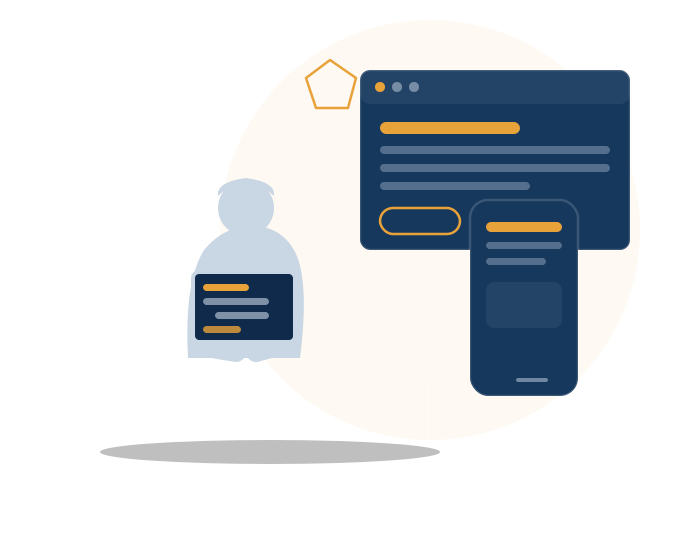
Built for businesses tired of software that was only ever specified.

Enterprise Web Applications

Internal platforms and customer-facing web apps built for your exact workflow.

Mobile Applications

Native and cross-platform iOS and Android apps for staff or customers.

SaaS Platforms

Multi-tenant products built to be sold, not just used internally.

Internal Business Tools

Purpose-built tools replacing spreadsheets and manual tracking.

API Development & Integrations

Connecting your systems to each other and to third-party services.

Legacy System Modernisation

Rebuilding ageing systems without disrupting the business running on them.

Engagement Models

Which model fits depends on how well-defined the scope is today, and how much it's likely to change.

01

Fixed Price

Scope, timeline and cost agreed upfront before development starts. Predictable budgeting with limited flexibility for major changes mid-project.

Best for: well-defined projects with a clear, stable scope.

02

Time & Material

Pay for actual work delivered as the product evolves. Adjust direction, priorities and scope without renegotiating a contract each time.

Best for: evolving products where requirements shift as you learn.

03

Dedicated Development Team

An embedded team of developers, QA and a project lead functioning as an extension of your own team, managed jointly with you.

Best for: ongoing product development needing sustained capacity.

Built the way we'd want to buy it.

  1. Discovery

    Requirements, constraints and success criteria mapped before anything is built.

  2. Architecture

    Technical design and stack decisions made before a line of code is written.

  3. Sprint Development

    Iterative builds with regular working releases, not one reveal at the end.

  4. QA & Testing

    Functional, performance and security testing runs throughout, not just before launch.

  5. Deployment

    A structured release, with monitoring and a rollback plan in place.

  6. Support

    Ongoing fixes, tuning and new features once real usage begins.

Technology Stack

Chosen for the project's requirements, scalability and your existing infrastructure — not a single default stack applied regardless of fit.

Frontend

ReactNext.jsVue.jsTypeScript

Backend

Node.jsPythonJava.NET

Mobile

iOS (Swift)Android (Kotlin)React NativeFlutter

Database

PostgreSQLMySQLMongoDBRedis

Cloud & DevOps

AWSAzureDockerCI/CD

AI / ML

Python (ML)LLM IntegrationRAG PipelinesVector DBs

How We Protect Your Code, Data and IP

Practical detail on how the work is actually handled for clients across India and the UAE — not a badge wall.

You Own the Code and IP

Source code, designs and documentation belong to you on delivery — not licensed back to us.

NDA Before Any Detail Is Shared

Confidentiality is agreed before requirements, architecture or data are discussed.

Code Review on Every Change

Peer-reviewed commits and version control on every project, not just larger ones.

Environment Separation

Development, staging and production environments kept separate to limit risk.

Access on a Need-to-Know Basis

Client data and credentials are restricted to the people actually working on the project.

Documented Handover

Architecture docs and deployment runbooks delivered alongside the software, not withheld.

How to Choose a Custom Software Development Partner

Five checks worth running before you commit to any vendor — including us.

01

Portfolio Depth in Your Sector

Ask for examples in your industry, not just impressive but unrelated work.

02

Engineering Seniority

Find out who's actually writing the code — a named, senior team or a rotating bench.

03

Process Discipline

Regular demos and visible progress, not a single reveal at the end.

04

Stack Alignment

Their proposed technology should fit your systems, not just their preference.

05

Post-Launch Commitment

Ask explicitly what support looks like after go-live, and who owns it.

06

An Honest Estimate

A real number comes after a technical workshop — a number given cold is a guess.

Why Businesses Choose LGS for Custom Software Development

A business-first approach to technology: strategy and delivery under one roof, not handed between separate vendors.

Scoped Honestly

A real estimate after a technical workshop — never a number given cold.

Senior, In-House Team

The people who scope the project are the ones who build it.

Integration-First

Your existing ERP, CRM or data sources considered from day one.

Support That Doesn't Vanish

Post-launch support included, not a new contract with a new team.

Every engagement is ultimately accountable to the Founder's Office — not a rotating account manager.

Custom Software Development Case Studies

Described by challenge, approach and outcome — never by client name or commercial terms.

Delivered

Web App · Dedicated Team

Multi-Site Operations Platform

Challenge
Operations tracked across spreadsheets, with no shared view across sites.
Solution
A custom internal web application with role-based access per site.
Outcome
One system of record replacing manual, disconnected tracking.
Delivered

Mobile · Fixed Price

Field Service Mobile App

Challenge
Field teams logging work on paper, with delayed office visibility.
Solution
A mobile app for real-time logging, tracking and reporting.
Outcome
Office visibility into field work as it happens, not days later.
Delivered

SaaS · Time & Material

Multi-Tenant SaaS Platform

Challenge
An evolving product needing to adapt as user feedback came in.
Solution
Iterative, sprint-based development on a time & material model.
Outcome
A live, multi-tenant platform shaped by real usage, not a fixed spec.

Questions, before you reach out

How much does custom software development cost?

It depends on scope, integrations and platform, so any number given before a technical workshop is a guess. We scope the work first, then give a fixed price or a time-and-material estimate based on what's actually required.

What's the difference between fixed price and time & material?

Fixed price suits a well-defined scope with few expected changes — you know the cost upfront. Time & material suits evolving products where requirements shift as you learn — you pay for actual work done and can adjust direction freely.

How long does custom software development take?

A focused first version is typically deliverable in 8 to 16 weeks depending on scope, with further features added in subsequent sprints.

What technology stack do you use?

We choose the stack based on the project's requirements, scalability needs and your existing infrastructure, typically from modern, well-supported frameworks rather than defaulting to one fixed stack regardless of fit.

Do you provide a dedicated development team?

Yes. Alongside fixed-price and time-and-material projects, we can embed a dedicated team of developers, QA and a project lead that functions as an extension of your own team.

Show 4 more questionsShow fewer questions
What happens after the software is launched?

We stay on for post-launch support — bug fixes, performance tuning and new features — since real usage after launch is usually where the most important issues and opportunities surface.

What's the difference between custom software and off-the-shelf software?

Off-the-shelf software is built for a general market and asks your business to adapt to it. Custom software is built around how your business actually operates, so the workflow fits the team instead of the other way round.

Can custom software integrate with our existing ERP or CRM?

Yes. We design integrations with your existing ERP, CRM or databases as part of the build, rather than treating the new software as a disconnected, standalone system.

Can you modernise or upgrade our existing software instead of rebuilding from scratch?

Often, yes. We assess whether the existing codebase is worth extending and modernising, or whether a rebuild genuinely serves you better — the answer isn't always a full rebuild.

Ready when you areGet in Touch